I admire the manner in which they once operated. Gloriously ill-advised.
Case in point, the Vasa:

Built in the early 1600s.
The thing was originally designed as a small/medium warship, one gun deck, etc.
But then later in the process they decided to actually make it into a fairly large warship. Halfway through building the keel, a combination of the king's demands and the unexpected death of the original designer, saw the half-thought-out lengthening of the boat, and then the addition of a second gundeck, as well as the outfit of a kind-of-ridiculous-for-the-time sixty four or so quite large guns.
But they didn't drastically change the design otherwise. Notably, they did not make the bottom/keel of the boat any deeper below the waterline.

It became quite clear quite soon, that this was going to result in a ship whose center of gravity was a bit on the high side. With a small ships' sized keel, the amount of ballast that could be carried was minimized. Which would be fine for a smaller ship. But then, with the second gun deck and all of those cannons added, the ship would require something more to counterbalance the mass that would be situated above the waterline.
But the Swedish king Gustavus Adolphus would hear none of these paltry engineering concerns and demanded that the huge ship join his fleet immediately to showcase the naval clout of his country.
The result was, well, this:

Or rather, well, this:

Its maiden voyage lasted about this long:

Which was oh, just about how long it took for it to find the first actual bit of breeze it encountered.
The wind caused well and properly mis-balanced vessel to heel over badly. Its (now many) gunports were unfortunately, open. Due to the insufficient depth/height of the keel, this meant that the gunports only needed to dip a few feet to be like, AT sea level. And so it came to pass that this happened and the ship quite rapidly filled with water and sank, killing a few dozen of her crew.








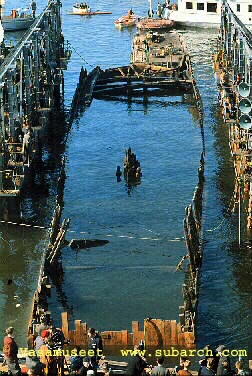




 What shape they're in... well...
